









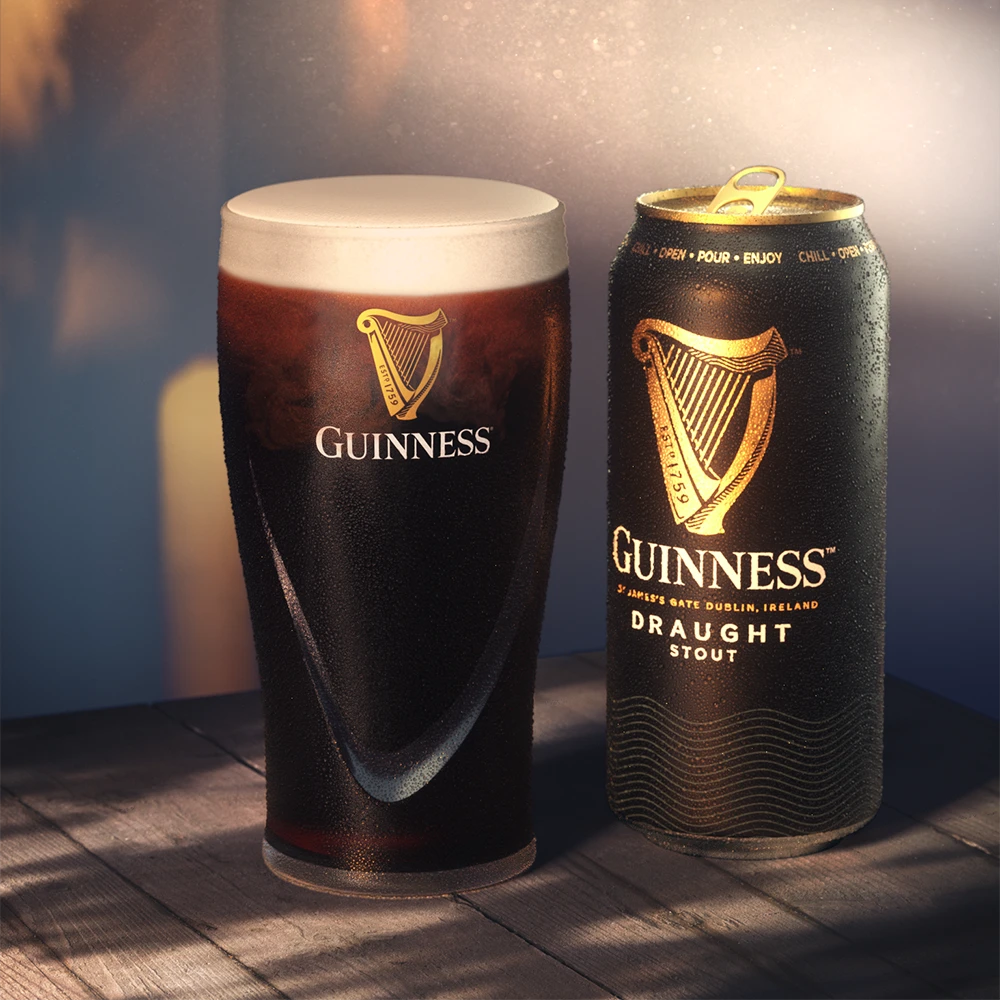
I love Guinness. I like the sturdiness and bitter character of the traditional bottled Guinness and the smoothness and creaminess of the draught, on tap or in a can. Most of all I am a Guinness voyeur. I like to watch Guinness settle in the glass, eventually arriving at an impenetrable black liquid, with two fingers of that white, tight bubbled, creamy frothy head. Though I love Real Ale, or what is also called in Britain, a pint of Bitter, I am mainly a lost cause having reverted to wine. But if I do have a beer, it is likely to be Guinness and sometimes when I see it is available, I can’t resist it!
Guinness is arguably the product most associated with Dublin in the Republic of Ireland. It is a dark stout that has always been there in a kind of reassuring way. Just as it was thought that bitters and stouts were in terminal decline, Guinness has within a few years pirouetted, been rejuvenated and has suddenly become the chosen beer of a young generation, that is not over keen on drinking alcohol. The results were shortages of beer in the peak times last year. It got so bad Guinness had to ration its own regular customers.
It was Arthur Guinness who founded the brewery in 1759 at the St. James Gate Brewery. He signed a lease for 9,000 years! It was a spot of genius to choose this site. It was close to fresh water sources which provided him with a good source of water, critical for brewing, but also the waterways allowed him to import and export with ease. He sold bitter first, but from 1799 they decided to revert to producing only dark porter beer. This was a hoppy, dark beer, made using roasted malt. Its name came from its popularity with the porters who worked in the local markets. The name ‘stout’ eventually superseded porter and Guinness became known as “Extra Stout.”
Arthur Guinness used the harp as his logo. Only later was it adopted as a symbol of the country and it may now be found on coins, passports and official documents of state. Over the years the harp has changed. The newer designs are more streamline and have fewer strings. By 1833, Guinness was the largest brewery in Ireland and by the 1880s it was the largest brewer in the world. It was estimated that one in every thirty people in Dublin was financially dependent on the brewery. Beers were delivered in casks of different sizes by magnificent looking dray horses. Today the brewery is technologically advanced as anywhere and the brewery is the most visited attraction in Ireland.
Guinness is made from a mixture of malted, un-malted and roasted barley. This provides body and a malty sweetness. A high proportion of hops are added. This acts as a preservative (important in the days Guinness was shipped) and provides the bitterness which contrasts the sweetness. The water comes from springs in Wicklow Mountains, 16 km south of Dublin. It is a good water for brewing being low in mineral content. The final ingredient is the yeast which eats the sugars in the malted barley and produces alcohol and carbon dioxide. A special culture of the Guinness yeasts is kept under lock and key for security. Just in case!
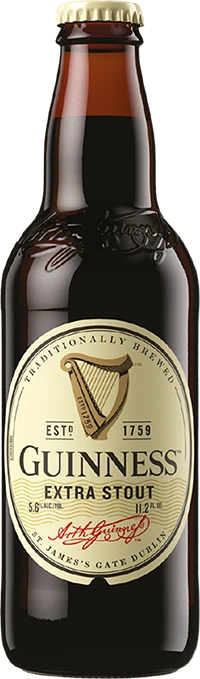
The Guinness Extra Stout was first sold in 1821 and from 1834 it was sold in glass bottles. It is fuller, bolder and bitterer than the draught. It became the core product of the brewery. They themselves describe the aromas as robust and roasted with intense notes of dark chocolate, caramel and dried fruits. The appearance is black with a frothy head. The taste is full bodied with coffee notes balanced by subtle sweetness.
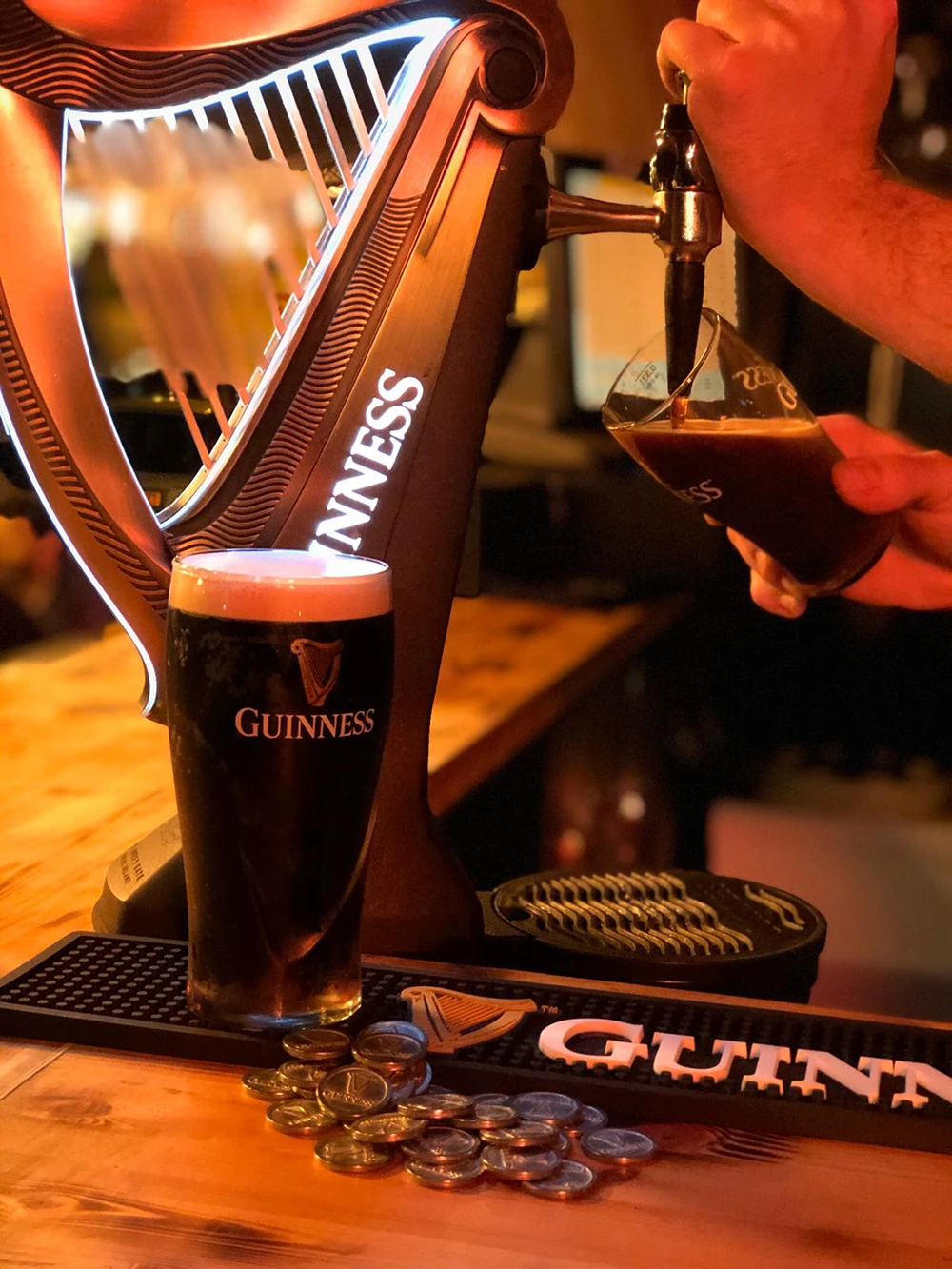
In 1959 Guinness began using nitrogen which made for a creamier, smoother taste. This was the beginning of the new wave of Draught Guinness. The two-stage pouring ritual became common place. It works like this. The glass should be filled slowly at an angle of 45° so it does not froth up. When three quarters full, the glass should be put down to allow the Guinness to rest and settle. What you see is like storm swirling in the glass, with the bubbles appearing to be dragged down the walls of the glass, whilst rising in the center. However, all calms down in a jiffy, and in the end, there will be a clear separation between the creamy head, and the main body of dark beer. Guinness insists it takes 119.5 seconds to pour the perfect pint.
The Guinness website describes the aroma of the draught Guinness as hints of roasted coffee and chocolate; the appearance as dark ruby red (very dark that is!) with a creamy head; and the taste as smoothly balanced with bitter, sweet roasted notes. When you take a mouthful you taste the sweetness of the malt on your tongue, the roasted flavor on the sides of your tongue and the bitterness at the back of your throat.
Draught Guinness was replicated in cans with the invention of a widget from 1988. The widget is a hollow sphere that rests in the can until it is opened. On opening, the pressure drops and the widget jets nitrogen through the beer, producing the iconic creamy head.
The first brewery outside Ireland was opened in London in 1936. Guinness is now brewed in 48 countries and distributed in 120 countries and believe it or not, Nigeria is the third largest market after Ireland and the United Kingdom. The advertising of the brand is iconic. The first poster making the claim “Guinness is good for you” first appeared in 1929. The slogan of “My goodness, my Guinness”, usually combined with one of John Gilroy’s famous animal posters, also caught on. This also led to the toucan posters which became associated with the brand. The “Pure Genius” campaign was another that was very successful.
Whilst the battle on the bar for ales and lagers was very intense, Guinness retained its position as the main stout and therefore even in bad times it was very well distributed. It therefore maintained its status as a unique company. In 1986, in a move that electrified the drinks industry, Guinness bought the Distillers Company. It was a deal that was in the news for years because of high profile court cases that took place following on from this. The deal brought together the strengths of Ireland’s largest brewery, with the largest distiller and marketer of Scotch whiskies. This combined the main symbols of Ireland and Scotland. In 1997, the company merged with Grand Metropolitan to form Diageo, which still exists today. It remains the largest sprits company in the world. The company’s head office is in London and their most famous products are Johnnie Walker Whisky, Smirnoff Vodka, Gordon’s Gin…and Guinness.
I started my career in the drinks industry with Bass Charrington, then the largest brewery in the UK. For a time, I worked out of the Charrington office at Park Royal, in northwest London. On the same street was the Guinness London brewery. You never forgot Guinness was nearby because of the aromas. The air reeked with all the pervasive yeasty smells coming from the brewing process. It was not an unpleasant smell, but if you did not know what it was, it could be disconcerting. Eventually I moved from beer to wine and from pubs to hotels and restaurants, but that introduction to the production of Guinness was something I have never forgotten. Sadly, the Park Royal brewery closed in 2005. The total production returned to Dublin. I wonder if they regretted that decision when they ran out of product last year?
When I came to Israel on holiday in 1978, I was astonished to find cans of Guinness sold in Jerusalem. So much so, that I took one home as a souvenir. I love the fact that it was written in Hebrew. As someone newly in the beer industry, I thought this showed the international strength of the Guinness brand, but I also remember thinking that of all the famous beer brands, it was most unsuitable for the hot climate. I wondered who on earth would be drinking it, because few drank beer here in those days. Previously during the time of the British Mandate, the British soldiers were the beer drinkers. When they left, beer sales crashed. Of course, Israelis began to drink more beers under the auspices of Tempo Brewery of Netanya from 1985, and in 1995 the Carlsberg IBBL established their brewery in Ashkelon. A mini craft brewery revolution occurred in the 2000s and global brands were imported. Gradually Israelis began to drink beer, but consumption is still pitifully small. We have never got over 14 liters per head.
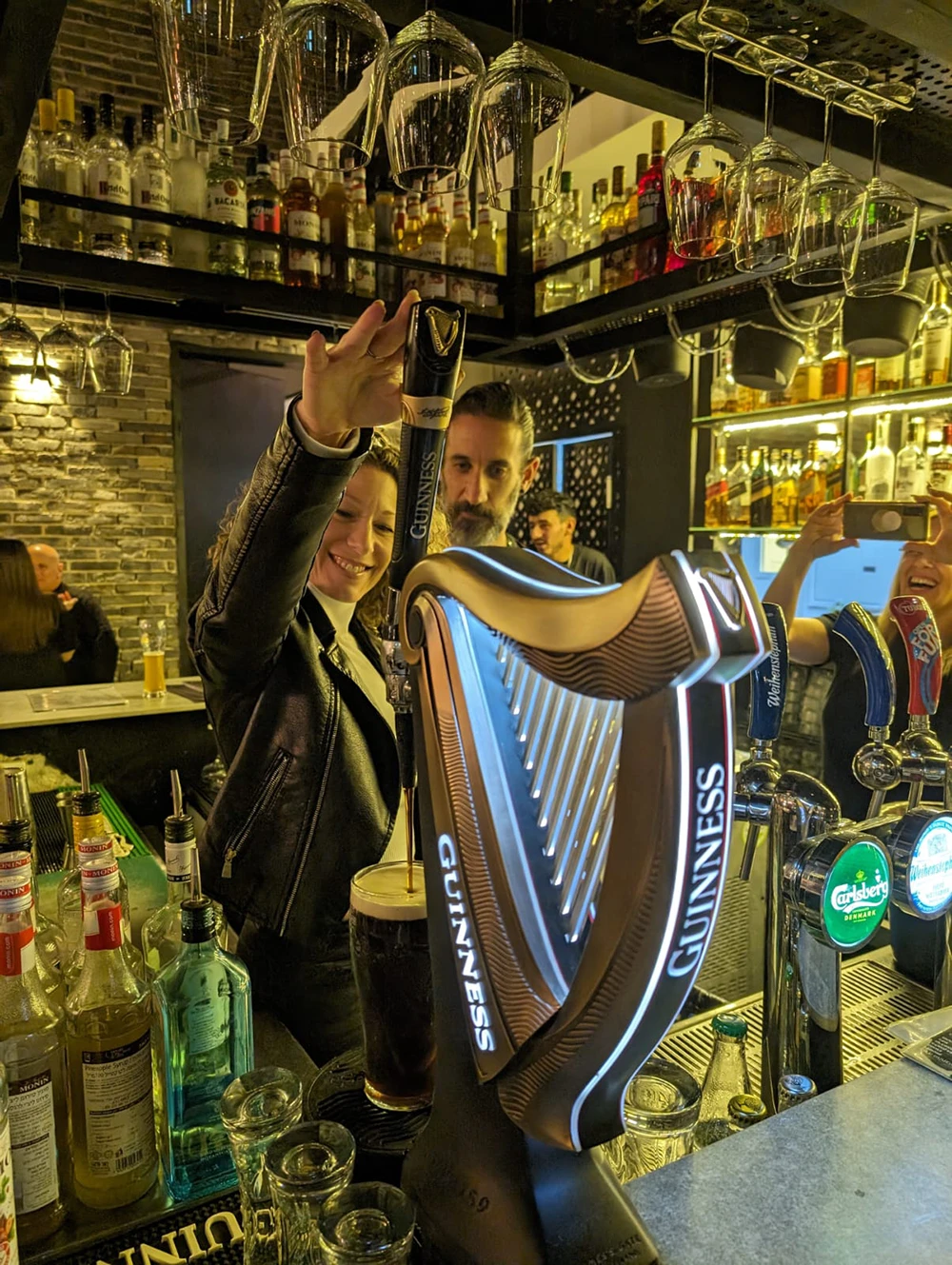
Since 1996, Guinness has been imported to Israel by Carlsberg IBBL, part of the CBC Israel Group. Here the traditional bottles are sold showing Guinness in its purest form. Now there are also cans of Guinness with the draught effect (thanks to nitrogen and widgets). Also, the draught version is available, but there has to be a minimum turnover to justify this. If the pipes and taps are dirty, too warm and it is not poured regularly, it can be impossible to pour a quality Guinness. So, Israel bars will only be permitted to sell on draught if the sales are there to turn around a keg quickly. However, if you find Guinness on draught, it is a celebration. Last time I came across it was in Muza Restaurant in Arad. Though I was the guest of Yatir Winery, I felt compelled to order a glass of the black stuff!
Guinness may also be used for cooking. Adding it to a hearty beef stew, using it in the batter to make fish and chips and matching it to oysters all became popular for foodies. Guinness aficionados were not just prepared to drink it. They also wanted to cook with it and match it to the food.
 By the early 2000s Guinness was considered tired, old fashioned and passé. Sales were declining. The generation of loyal Guinness drinkers was getting older. However, in recent years, the brand has somersaulted, made itself relevant to a new generation and sales are suddenly booming again. It is an amazing turnaround which is due to clever advertising, an excellent and persistent social media presence, efficient distribution and a return to basics and authenticity. It has become more popular with female drinkers, the new young crowd and found favor with celebrity drinkers, which never does any harm. One of the reasons Guinness became so popular with the younger generation was the game known as splitting the G. The test, if you are drinking Guinness in a branded glass, is to take a gulp with your first sip so that the remaining drink splits the G of the word Guinness stamped on the glass. The result of Generation Z’s infatuation with Guinness meant that sales in Europe increased by 18% in 2024 and 6% in America. The 266-year -old company is seen as trendy again.
Whilst writing this I am drinking a bottle of Guinness Extra Stout to lubricate the brain cells and keep the writing fluent. I notice on the label the words “Dark and Lively.” That is a pretty succinct description. No doubt, lovers of the black stuff have made Guinness great again!
Adam Montefiore is a wine trade veteran and winery insider turned wine writer, who has advanced Israeli wines for 38 years. He is referred to as the English voice of Israeli wine and is the Wine Writer of the Jerusalem Post. www.adammontefiore.com