The official wine regions of Israel have been a bit of a joke since I came to Israel 37 years ago. Whilst wineries and growers took Israeli wines to the heights, the administration of the Israeli wine trade could not keep pace. The official regions were decided in the mid-1970s but this was before the Israeli wine industry changed, developed, improved standards, grew and moved eastwards and northwards in search of altitude. The Israeli wine industry founded by Baron Edmond de Rothschild was focused on the northern and central coastal plain. The wine revolution began in the 1980s on the Golan Heights. Seeking greater quality, the majority of vineyards moved to the Upper Galilee, Golan Heights and Judean Foothills. More recently was the revival of historic wine routes in the Negev and Samaria. The wine industry today bears no resemblance to what it was fifty years ago.
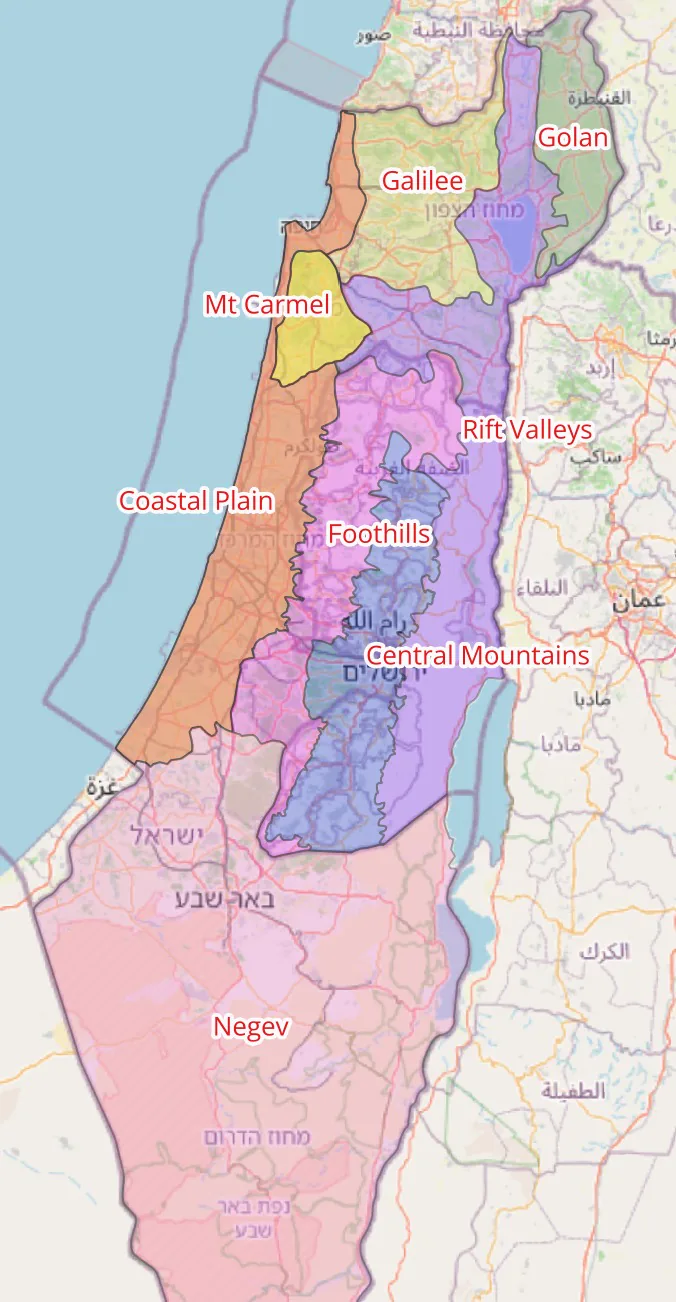
The official wine regions decided in the seventies were the Galilee, Shomron, Samson, Judean Hills and Negev. The sub regions included Nazareth, Kfar Cana, Sharon, Dan, Latroun, Hebron and Jerusalem. There was only one problem. The new Israeli vineyards were not planted in these Biblical and historic places. The Shomron region (using the Hebrew word written in English) covered from Zichron Ya’acov to Samaria, from coast to mountains. No-one really understood what Samson (written in English) and Dan region represented. The regions were divided horizontally, when in actual fact much of the topography of the land is vertical (coastal plain, rolling hills, central mountains, rift valley and desert).
Every exported wine has to put a region on the label. The failure of the official regions may be understood when you know that the majority of our exported wines use only two regions on the label: Galilee and Judean Hills. Even today, it is as though Israel is covered by these two names alone. Those on the Golan Heights use Galilee for political expediency. And those in the Judean Foothills, Samaria, and Yatir Forest, use Judean Hills. These are our two most well-known and well-used appellations.
For 25 years I have hoped this would be changed and updated. I watched efforts led first by the late Shlomo Cohen, director of the Israel Wine Institute (part of the Ministry of Trade and Industry.) Then Eran Harcavi, viticulturist of the Ministry of Agriculture, took up the baton. He was followed by Tzachi Dotan, director of the Wine & Vine Council. They each in turn struggled with this immovable object. I know. I was on some committees and a consultant on others and I was always pushing for change as an interested party.
Despite being world leaders in hi-tec and advanced technology, we are surprisingly backward in low-tec and are handicapped by being a third world country in bureaucracy. We are famous for our advanced technology and agricultural prowess, clearly illustrated in our wineries and vineyards, but to create an up-to-date wine map was a step too far.
My unofficial job is to represent Israel’s wine regions to the world of wine, in particular the classic tomes like The World Atlas of Wine and The Oxford Companion To Wine. I was always left looking stupid when I said to authors of the most important wine books in the world “any minute now, there will be a new Israeli Wine Map.” I said this repeatedly over 20 years. But it never happened. I have represented our wine regions for the books of Hugh Johnson, Robert Parker and Jancis Robinson MW, the three most famous wine writers or critics of the last 40 years.
I once got into a conversation with Tom Stevenson, author of The Sotheby’s Wine Encylopedia. Whilst struggling to give an explanation, I said something like “well, we are a young country without final borders yet, which may explain why we have not got an appellation system.” This was quoted in the published text which was a little embarrassing. But it explains the tightrope I have had to walk on.
In 2020, there was a breakthrough. IPEVO is the official body representing Israeli winemakers and viticulturists. Victor Schoenfeld of the Golan Heights Winery is the founding Chairman. Israel’s first Master of Wine Eran Pick of Tzora Vineyards took a lead in IPEVO’s project to establish and publicize a professional map divided into fifteen regions. It was a first step to normality. Since then, I was able to use this map in my explanations, though it only covered vineyard areas.
This acted as a catalyst. Since then, there have been committees, suggestions, revisions and sometimes accusations of a conflict of interests amongst some of the larger wineries. A proposal was published. Then at the beginning of this year, the clouds blew away, the sun came out and Israel finally got its act together. A committee was appointed with the express objective to fast forward decisions to a successful conclusion. The dynamic chair was Pnina Oren Shandor of the Ministry of Health and she was supported by Nataly Brudner Mor of the Ministry of Agriculture and Tzachi Dotan of the Wine & Vine Council.
Of most interest to me were the wine professionals on the committee. These were viticulturist Noa Maoz (Israel Wine & Vine Council); winemakers Dr Shibi Drori (Gva’ot Winery and Ariel University) and Ed Salzberg (ex-Barkan); Adv. Edan Barulfan DipWEST, an expert in Wine Law and a specialist in registering Wine Regions; and me (ex- Golan Heights Winery and Carmel).
A professional sub committee was formed by Noa Maoz, which included Shibi Drori, to make detailed recommendations. They took into account all the professional parameters, like terroir, soils, climate and elevation. Herzl said “if you will it, it is no dream” or as we might say “where there is a will, there is a way.” Sure enough, a few months later, white smoke could be seen coming from the meeting rooms of the Ministries of Health and Agriculture. The first new Israeli wine map for fifty years was agreed. Hallelujah! Pnina Oren Shandor, Nataly Brudner Mor, Tzachi Dotan, and above all, Noa Maoz, deserve a great deal of credit.
Though winemakers, viticulturists, and growers will swear on the importance of these wine regions, I am a little more cynical. The most important use for this new map is marketing. We are at a stage when the varietal dominance is declining. Blends are becoming more prominent and soon people will be talking more in terms of regions, sub regions, single vineyards, and individual plots. Whereas once we identified a wine as a Cabernet Sauvignon or Merlot, in future we will be talking about the region. It is all a question of discovering a wine’s identity.
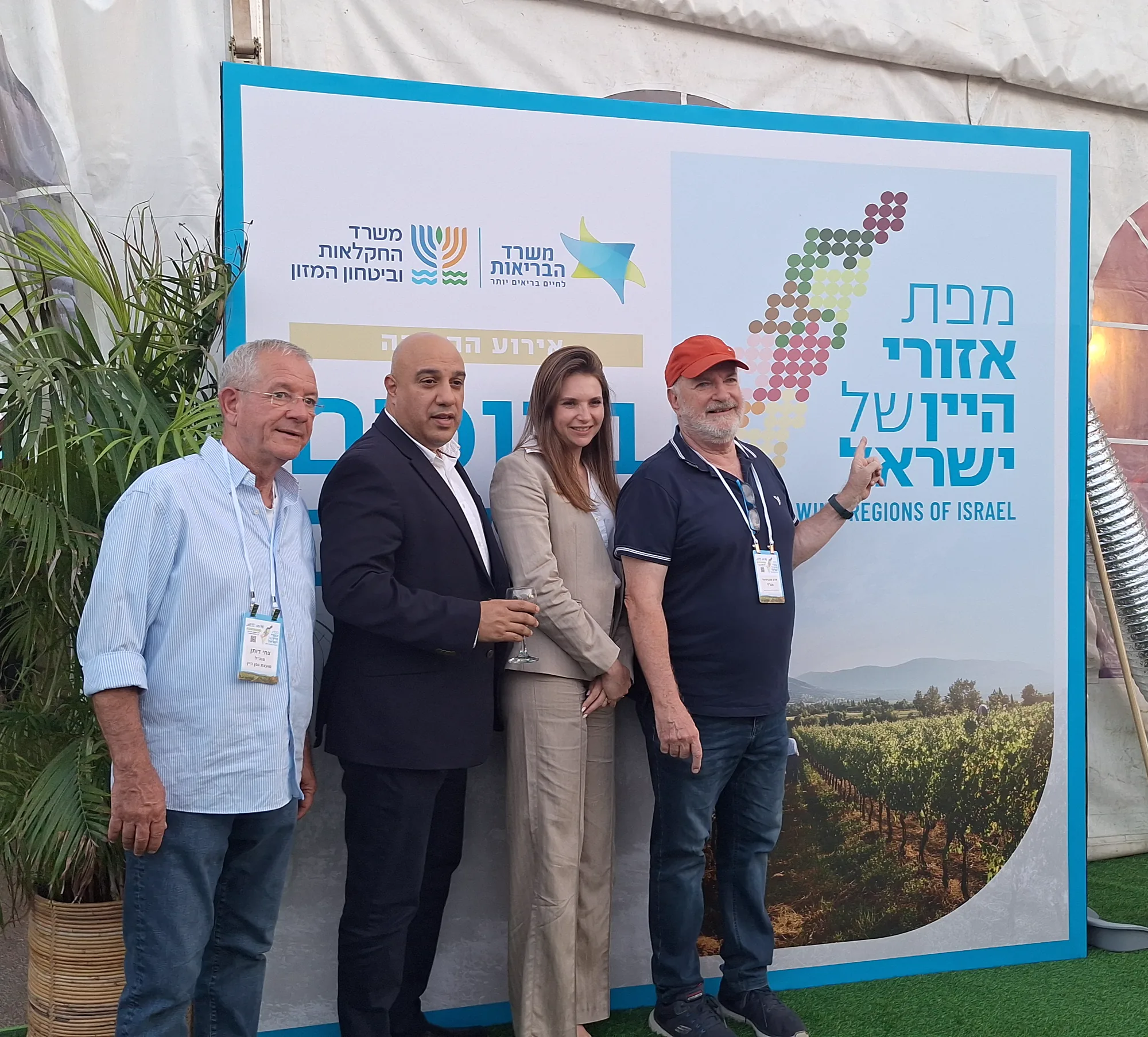
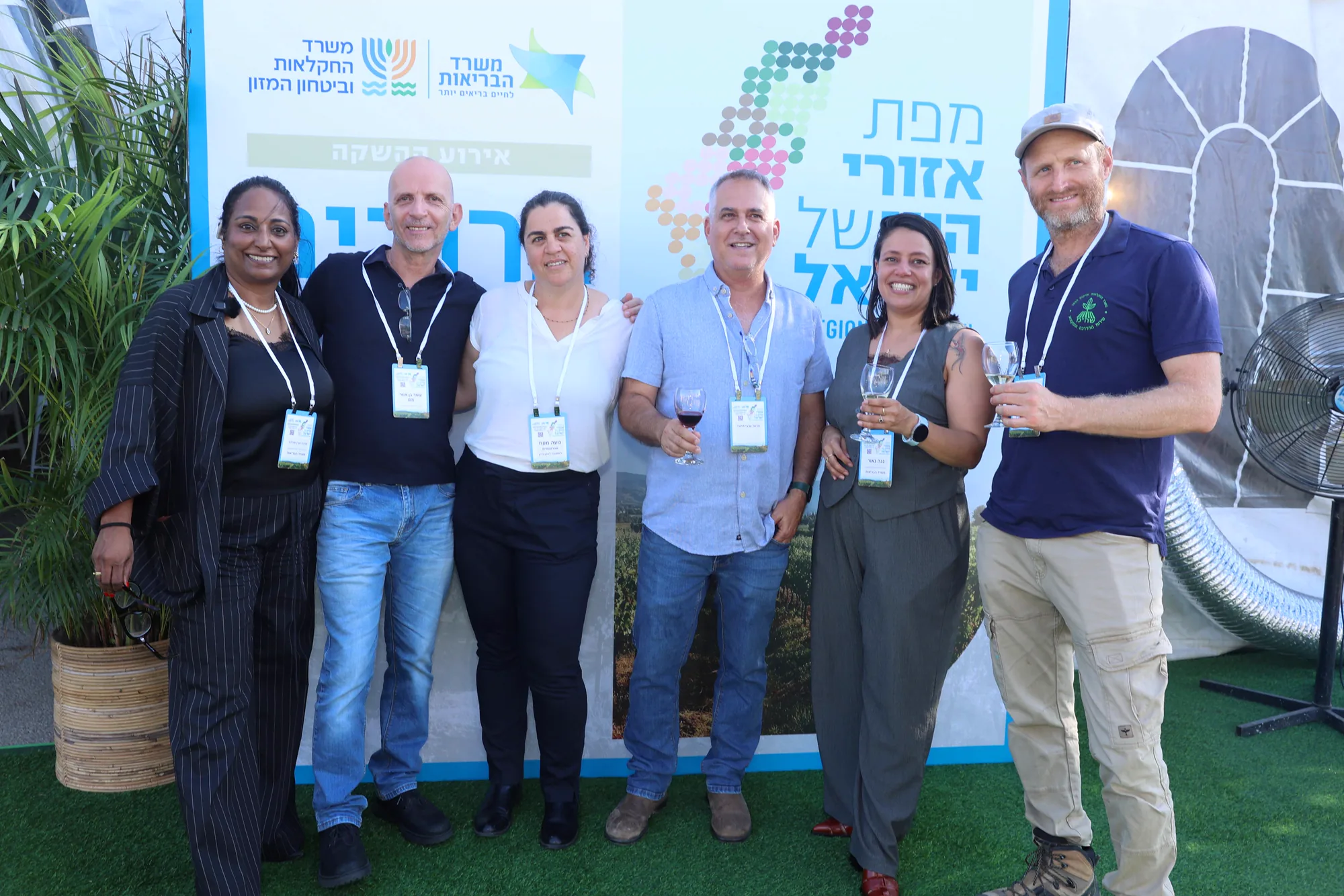
The new wine map was launched on at the Ministry of Agriculture in an impressive event. An impressive tent was erected, with a place for schmoozing, eating and drinking, and a large seating area for the presentation. At the entrance was an amazing mosaic puzzle of red and white grapes made into a likeness of Baron Edmond de Rothschild, who founded the Israel wine industry.

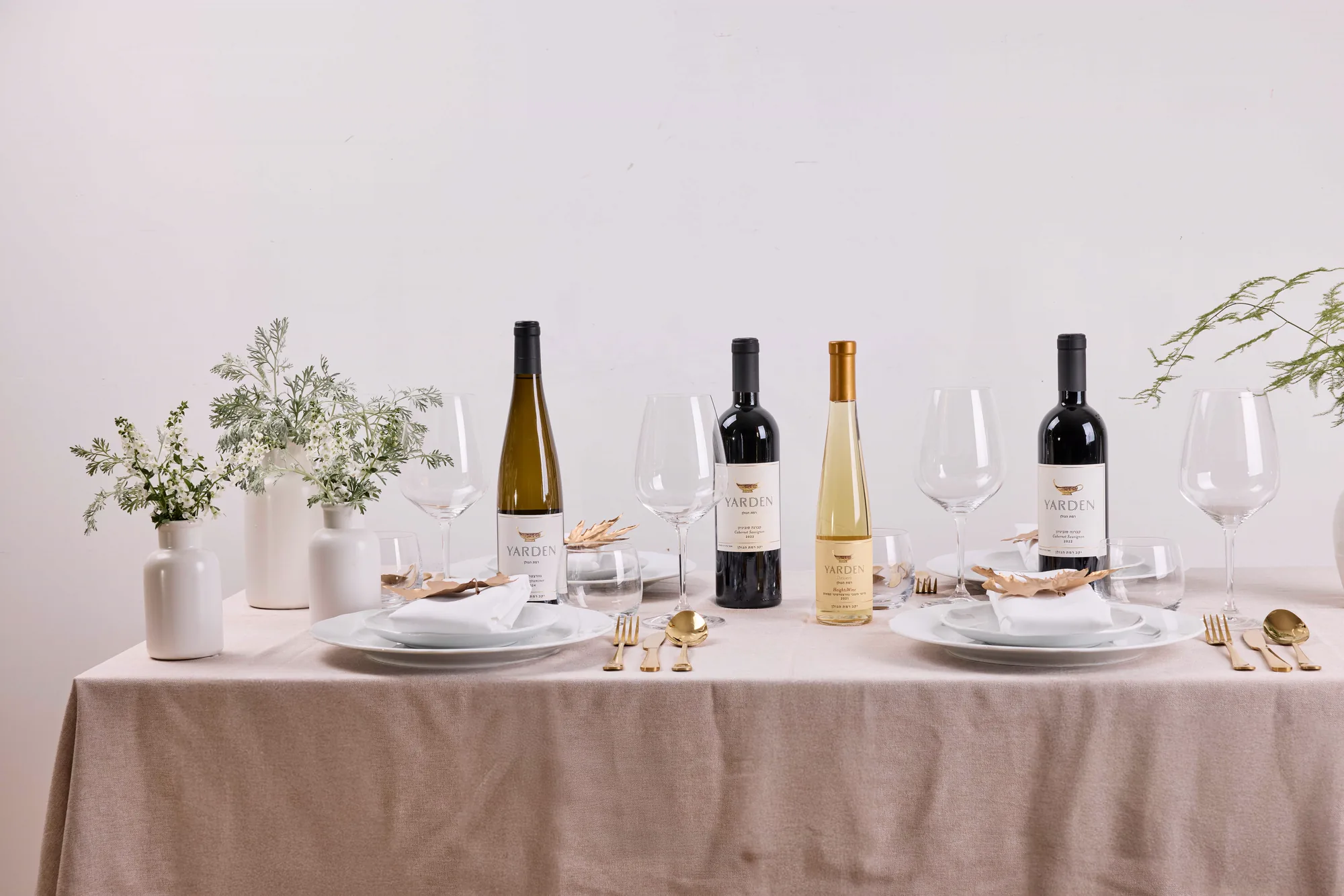
The wine industry and wine growing agricultural sector arrived in force. It was an impressive and historic event. A long-awaited milestone. The only failure, absurd when you consider the subject of the event, was the wine service. The wines (Yarden Chardonnay and Barkan Platinum) were served warm and the wine glasses were like those used by Carmel Mizrahi in the 1980s. More like large egg cups than the Paris Goblets that came later. Highly inappropriate. Fortunately, that was the only aberration. The event was otherwise professionally organized and the presentation was informative and well done.
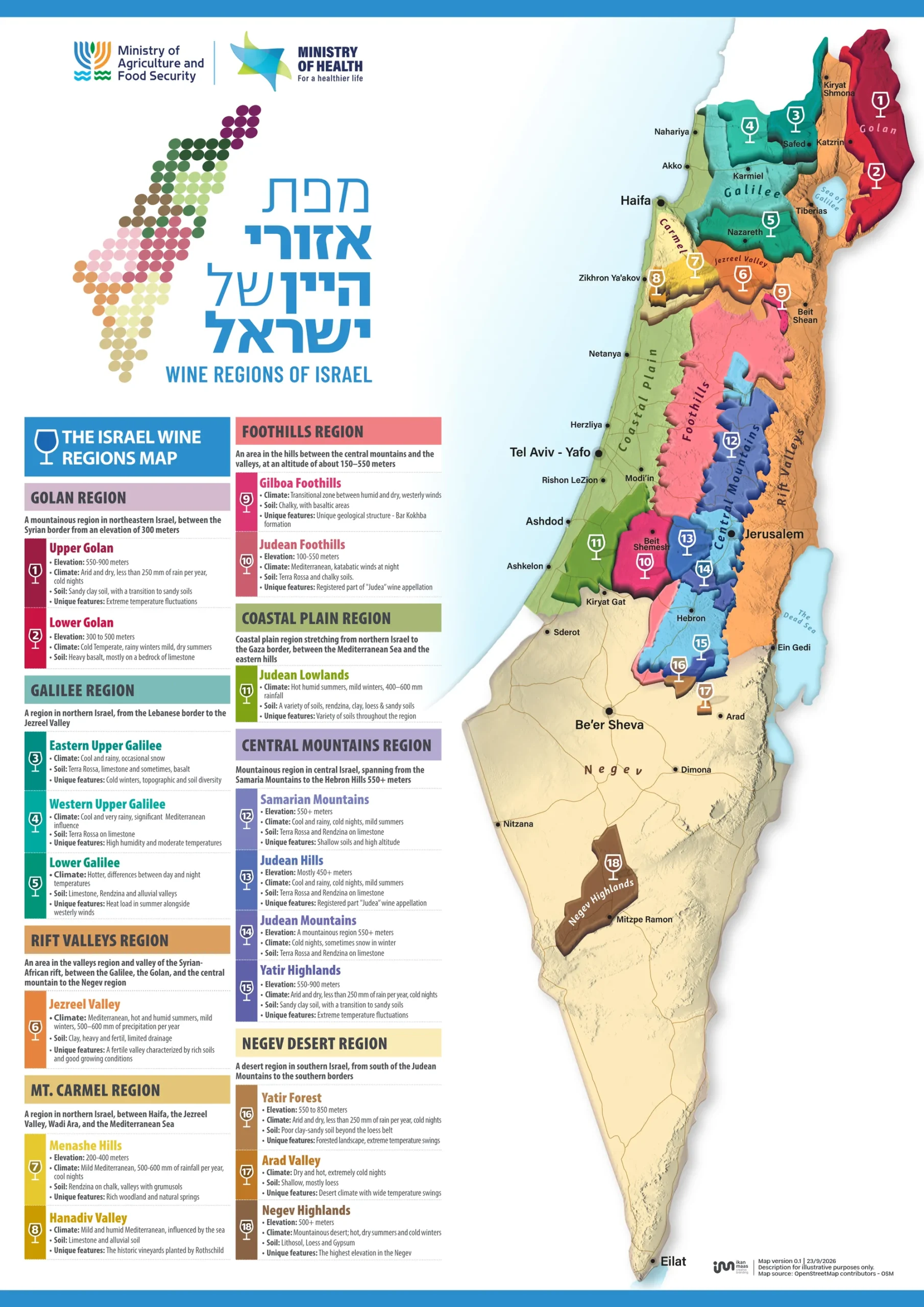
Overall, I think a good job has been done. Hugh Johnson once said that wine is liquid geography. A serious wine country should have a proper wine map. Well, it has taken a while, but we now finally have our updated map. There are eight regions and eighteen sub regions. The main regions cover larger areas, whilst the sub regions are places where there is a concentration of vineyards. Names like Galilee, Samaria, Judea, Mt Carmel and Negev echo from ancient maps. These are some of the oldest names known as they were in Biblical times. Exporting wineries may choose a region or sub region where 85% of the grapes come from. However, if it does not apply (say it is a blend from all over) the fallback option, is that they can write “Israel” as the region instead.
The Golan Heights is named as a region for the first time. This is the wine region which initiated the Israel wine revolution led by the Golan Heights Winery and Yarden wines. It is divided into the Upper Golan and Lower Golan according to elevation. This is why the Western Central Golan is part of the Lower Golan, whilst the Eastern Central Golan is part of the Upper Golan.
Of course, to the world the Golan Heights is still part of the Occupied Territories. This is unfair, ridiculous and illustrates a massive failure in Israeli diplomacy and PR. There is no moral problem on the Golan, there are no Palestinians living there. Israel was attacked and won the war and the Golan reverted to Israel. With the best will in the world, if Israel wanted to return the Golan Heights, to whom would they give it to? Possibly to the tyrants Assad & Son or to the broken, divided Syria of today? As a standalone issue, there is no earthly reason why the Golan is still tarnished with this absurd tag. Certainly, the Golan Heights has had a long Jewish past. More ancient synagogues have been found on the Golan than anywhere else in Israel.
The Galilee is arguably most famous Israeli wine region with resonance in both the Jewish and Christian worlds. Archaeologists found the largest Canaanite wine cellar ever found in the Galilee, which is also where the turning water to wine miracle occurred in the New Testament. Most of the wineries and vineyards are situated in the Eastern Upper Galilee. This is separated from the Western Upper Galilee, west of Mount Meron, where the terroir is definitely different. Then there is the Lower Galilee at lower elevations that completes the Galilee Wine Region.
The northern area is completed by a region called Rift Valleys, of which the sub region is Jezreel Valley. A 5,000-year-old Canaanite wine press was recently discovered in the Jezreel Valley. Fast forward until today, Carmel’s new facility at Alon Tavor, the largest winery in Israel, is also in the Jezreel Valley.
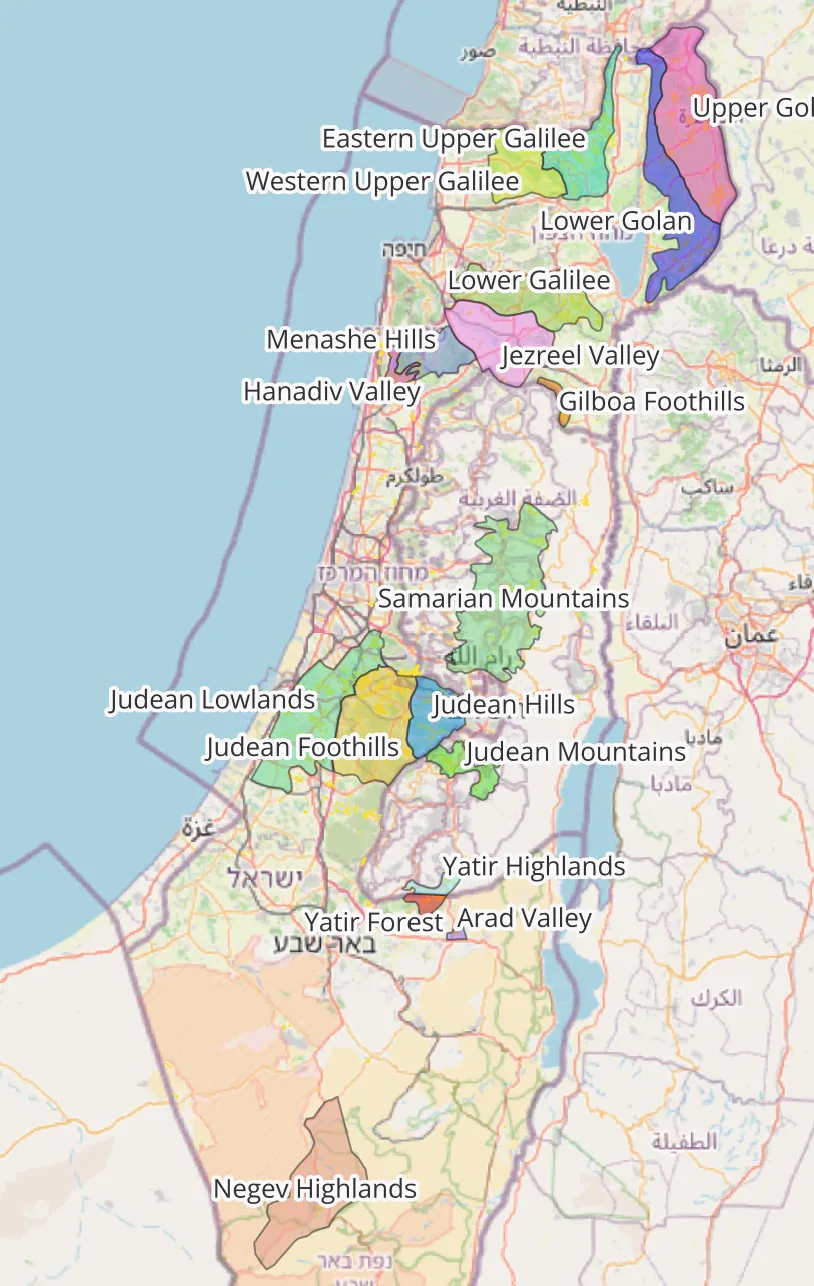
The most traditional wine region, where Israeli wine was reborn, is the Mt. Carmel Region. Carmel’s Zichron Ya’acov Cellars, Israel’s oldest existing winery building, is situated there. The main vineyard area is in the valleys of the southern slopes of Mt. Carmel around the winery towns of Zichron Ya’acov and Binyamina. The sub regions are called Hanadiv Valley and Menashe Hills.
The Coastal Plain Region is self-explanatory. The largest Byzantine winery complex ever found was discovered at Yavne. The named sub region is the Judean Lowlands, south east of Tel Aviv. There is a Foothills Region and the sub regions are the Gilboa Foothills and Judean Foothills. The rolling hills between Tel Aviv and Jerusalem make up the Judean Foothills. There are many wine presses to be found where the Judeans once made wine more or less over a 1,000-year period.
The mountain range that runs down the spine of the country is referred to as the Central Mountains Region. If you say West Bank you are regarded as a leftie, and if you call it Judea & Samaria, you are taken as being on the right wing. Central Mountains is a topographical description. The sub regions of the Central Mountains are the Samarian Mountains (north of Jerusalem), the Judean Hills (in what is known as the Jerusalem corridor), the Judean Mountains (around Gush Etzion) and Yatir Highlands (in the southern Hebron Hills.) The Judean Hills is the region with the most attention in recent years, particularly because of the activities and prominence of the Judean Hills Quartet, which includes Domaine du Castel, Flam Winery, Tzora Vineyards and Sphera. Ancient terraces is a feature of this area. In the Judean and Samarian Mountains is a revival of grape growing that there was in Biblical times. Most of their vineyards were only planted since the beginning of the new millennium.
Then there is the Negev Desert Region. This is the largest geographical area (over half the country), with the smallest vineyard area. Yet there are 60 wineries and vineyards there, from the Kiryat Gat to Eilat. It may not be our best quality region, but it is certainly our most interesting. The sub regions are Yatir Forest, Arad Valley, and the Negev Highlands. This is where the Nabateans and Byzantines had large wine industries. Recently the oldest identified grape pips were discovered at Avdat in the Negev.
Fifty years ago, 90% of Israeli wine grapes were planted in the coastal regions. These days the biggest concentration of vineyards is on the Golan, in the Foothills (mainly Judean Foothills) and the Galilee. Forty two percent of Israeli vineyards are in the north (Golan and Galilee), so often under attack in the last three years, including for a successive 12-month period from 2023-2024. The most well-known Israeli regions for quality wines are arguably the Eastern Upper Galilee, Upper Golan and Judean Hills. The most recent wine region to flourish is the Samarian Mountains. Possibly the most fascinating region especially to wine professionals overseas, is the Negev.
The most advanced wine regions in terms of marketing themselves are Judea (the Judean Foothills and Judean Hills) and Negev. They hold events to advance their region. Both regions have recently formally registered their appellation (in wine speak) as GI’s – Geographical Indication. Let’s hope others follow suit and work together to advance their regions in terms of quality, image and tourism
Israel is a tiny country, with a slim waste, the size of Wales or New Jersey. Yet like other long thin countries (thinking of Italy and Chile) we have an amazing variety of microclimates and terroirs. Our new official wine regions will reinforce our message and assist us to tell our story.
The writer is a wine trade veteran and winery insider turned wine writer, who has advanced Israeli wines over four decades. He is referred to as the English voice of Israeli wine and is the Wine Writer of the Jerusalem Post. www.adammontefiore.com