The mountainous area running down the spine of the country is part of what is known internationally as the West Bank. Those on the right of the political scene call the region Judea & Samaria, names which emphasize Jewish roots, from the time of the Israelites and Judeans. Whether you call it the West Bank or Judea & Samaria (Yehuda v’Shomron), depends where you stand politically. These are politically charged names which when used, which will instantly betray your political persuasion. Personally, I prefer to call the region Central Mountains. This is a description that explains the topography, which is wholly appropriate for a wine region.
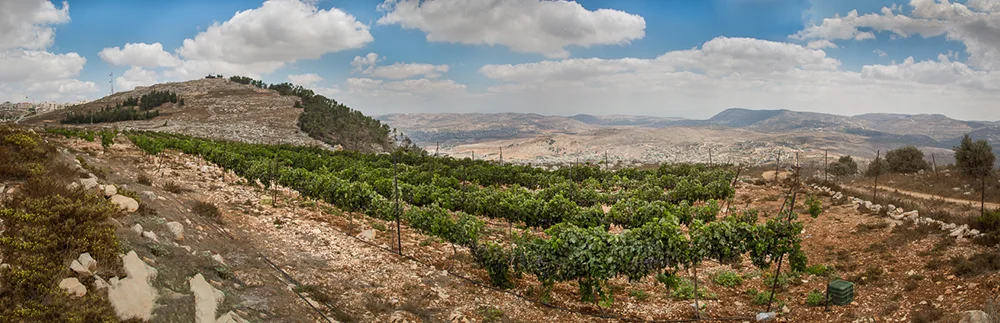
The Central Mountains is the region of Biblical Israel, the basis of Jewish tradition with breathtakingly beautiful views and sparse, stony mountain ranges. Elevations are high, up to 900 meters above sea level. Soils are shallow and poor, on a bedrock of limestone. Sometimes growers have had to drill holes into the stony soil to plant vines. There is none of the humidity that there is on the coast, and there are big differences between day and nighttime temperatures; It is ideal wine growing terroir. Wineries have planted vineyards here, really believing with all their being, that they are personally fulfilling the prophecies of the Prophets “…..they will rebuild and inhabit the ruined cities. They will plant vineyards and drink their wine.”
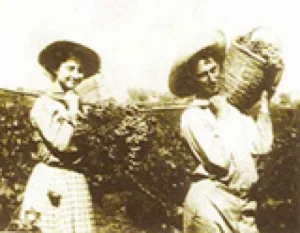
In Biblical times, every community grew vines. Grapes were one of the blessed species. Wine was important to the economy and essential for the religious ritual. Vineyards were planted on terraced slopes and in the valleys. There were wine presses, flat limestone basins, close to the vineyards where the wine was made. Then the wine was stored in amphorae in cool caves before they were consumed, exported or used for paying tribute. However, despite such a long history of grape growing, vineyards were planted relatively late in the modern era. In fact, it was not until the turn of the millennium, that the average wine lover became aware of wine from this region.
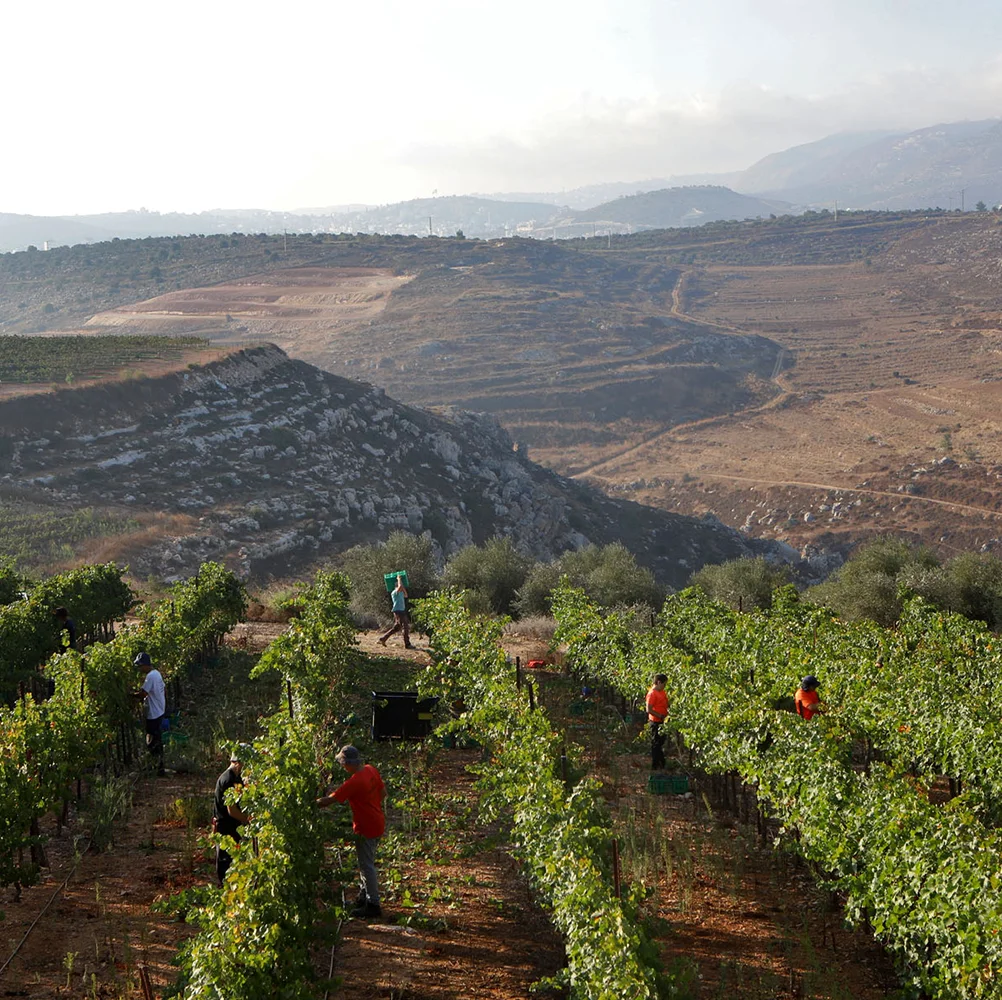
The first sign of the potential of the Central Mountains terroir in our times came only in 2002. Carmel Winery produced a single vineyard Merlot from Erez Ben Saadon’s Har Bracha vineyard, high up in the Samarian Mountains, at 800 meters elevation. It was one of the best Merlots in the country and it was a massive vote of confidence in the pioneers who planted the vineyard. This success spawned a whole new planting rush in the Central Mountains region. It was also convenient from an image point of view. The picture of settlers growing grapes and making wine, was certainly more positive than the often-televised image of bearded immigrants with American accents being seen to lord the land with Kalashnikovs in hand. Now, the wine region supports a varied wine route. There are number of wineries ranging from tiny domestic wineries to medium-sized commercial wineries.
This region particularly appeals to religious Jews, who see it as the land of their forefathers. It is therefore not a surprise that the most regular visitors to this region are religious Jews and Evangelistic Christians, some of whom return annually to work in the harvest.
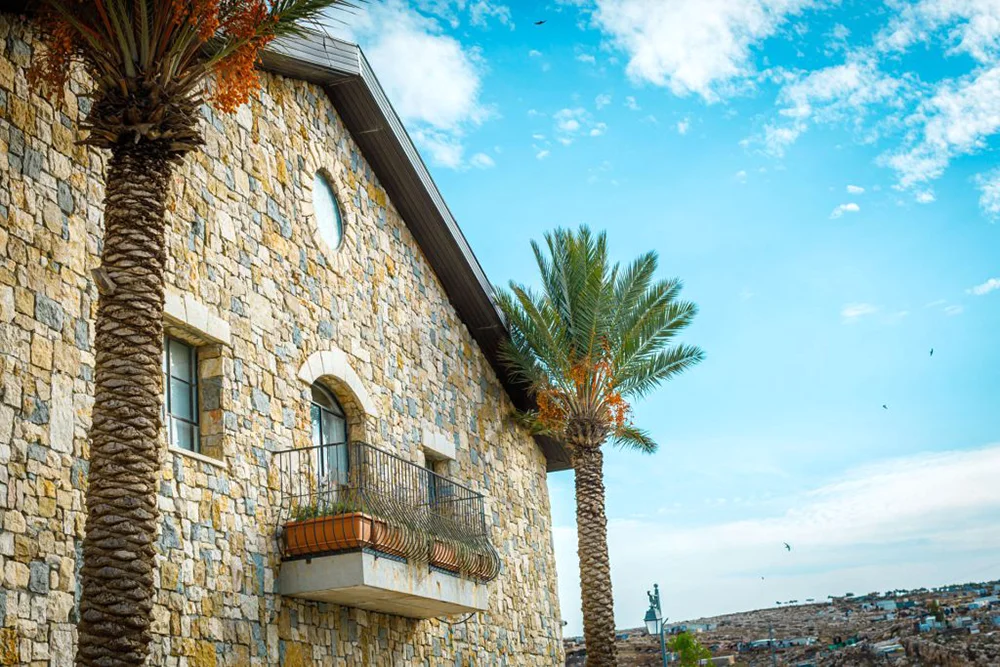
The region boasts Jerusalem at its center. Today only one Israeli winery has its fingertips in Jerusalem. That is Jerusalem Vineyard Winery situated at Atarot on the northern outskirts of the city. However, Jerusalem VW’s visitors’ center could not be more central or accessible. It is situated at the Montefiore Windmill in the Mishkenot Sha’ananim – Yemin Moshe neighborhood, in the heart of Jerusalem. Their Premium Rose and SLB (Sauvignon Blanc) are superb and great value. They also have a very good single vineyard Petit Verdot and Petite Sirah. It is an experience to taste these wines overlooking the Old City Walls of Jerusalem. Their CEO – winemaker is Lior Lacser, ex head winemaker of Carmel, who has proved himself both there and here as a winemaker of great talent.
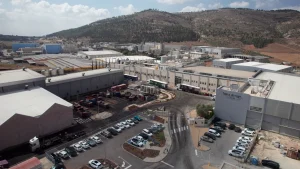
North of Jerusalem is the Psagot Winery, which was founded in 2004. This is largest of the Central Mountain wineries. It is a powerhouse with excellent sales particularly in the United States. It is also one of the most beautiful wineries in Israel. Psagot has a very respectable traditional method sparkling wine. I like their PR Rose and my favorite is their Peak, a big chewy, complex Mediterranean blend. They will be the next million bottle winery. Owner Ya’acov Berg is a force of nature, a human dynamo with immense drive and success in pushing for sales. His wife Na’ama has put the soul into a beautiful winery that seems sometimes to market itself more as an events venue than a winery. But they do have a very good winemaker. Canadian born Sam Soroka has made wine in five countries and is one of the most experienced winemakers here.
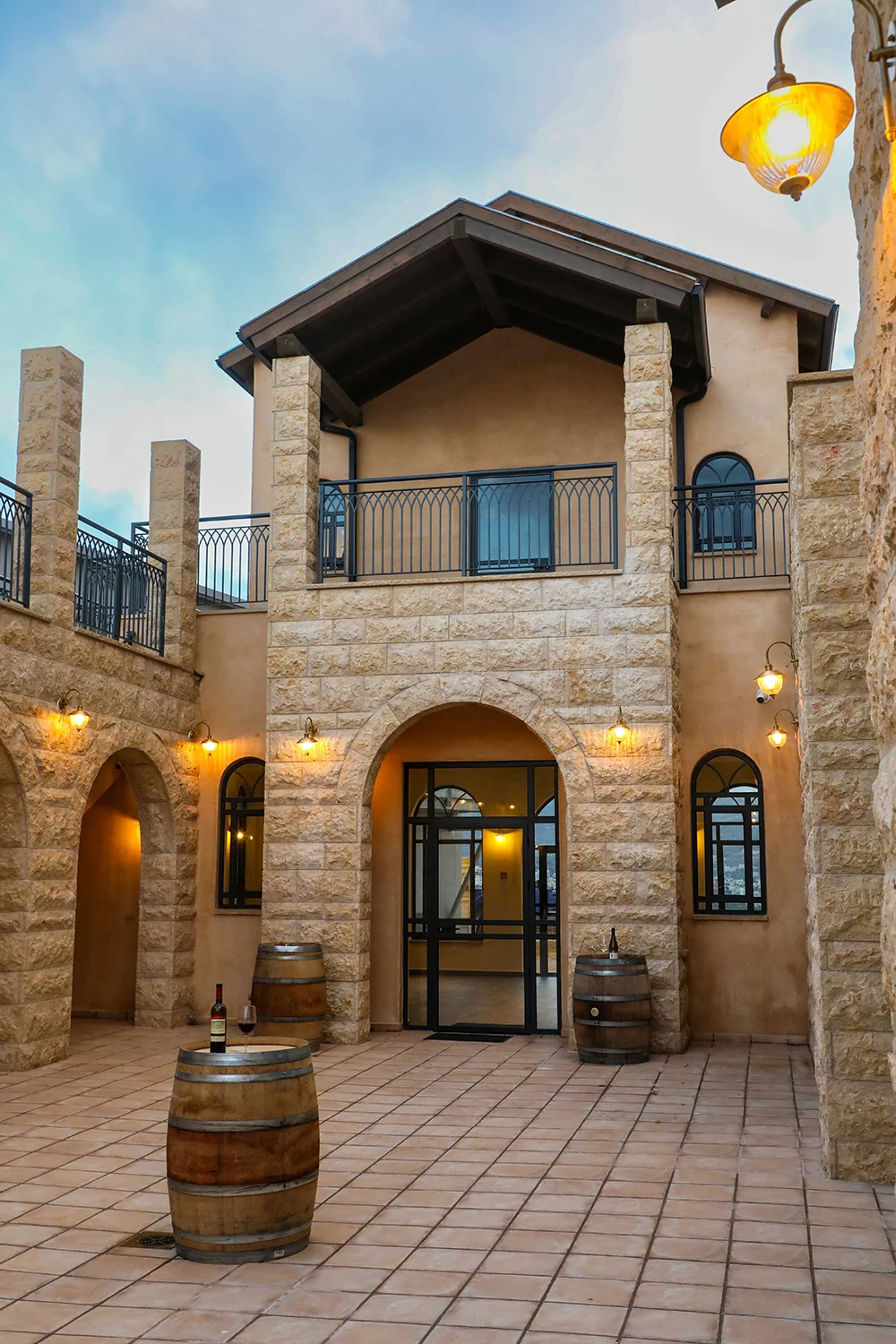
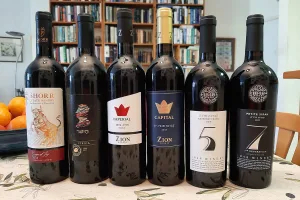
Shiloh is a place steeped in religious and Biblical significance. It was where the Ark of the Covenant was stored for a while. The archaeological site of Ancient Shiloh is situated nearby to the modern Shiloh. One shows evidence of ancient winemaking, the other houses a modern winery. The Shiloh Winery was founded in 2005. They are blessed with beautiful new premises. Their wines are much loved by judges in competitions, not just in Israel but internationally too. The Secret Cabernet Sauvignon has won the Israel Wine Awards (Eshkol Hazahav) first place gold medal no less than seven times. This is Israel’s leading competition. Their prestige Mosaic and Petit Verdot are excellent, and I also really like their relaunched Legend range, offering three wines in different styles. The winemaker Amichai Lourie is irrepressible and personally involved in every aspect of running the winery. His active presence particularly in the United States and on social media, is a lesson to all wineries that want to build image and sell more. I often say to wineries, if you want to do more, learn from the non-stop activities of Amichai Lourie.
Gva’ot Winery was founded in 2005. This is a small boutique winery situated on a hill overlooking the Shiloh riverbed. It is interesting to taste their Gva’ot Bittuni and the Hamdani Jandali blend. Gva’ot’s Gofna Cabernet Franc is very good, and they just may have the best Pinot Noir in the country. Their top Cabs are outstanding. I believe this is the finest winery in the Central Mountains. The winery is smaller than some of the others and is run with style and an emphasis on quality in the bottle. Winemaker Dr. Shivi Drori is also the Professor Elyashiv Drori of Ariel University, who is investigating and researching the indigenous grape varieties of the Holy Land. Israeli wine owes a depth of thanks for his painstaking work in saving and reviving varieties, which in future will be available for Israeli winemakers to play with.
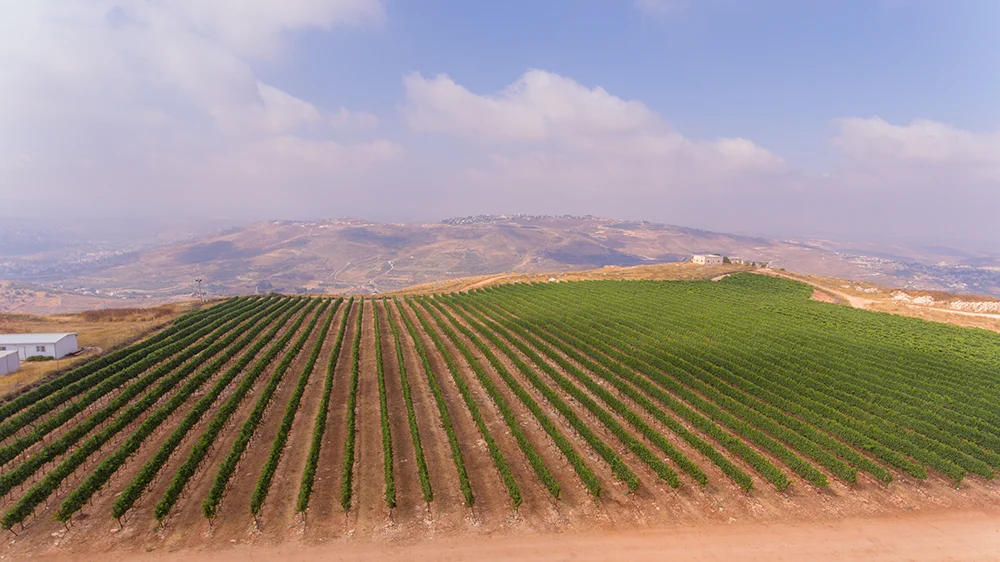
Tura Winery always seems to be in the news. On a recent Yom Ha’atzmaut, Israel Independence Day, the owner, Vered Ben Saadon was honored by lighting a torch, which in truth was more an honor for the settlement project in Samaria, than for the Israel wine industry has a whole. Politics apart, I still believe Israeli wine should receive the recognition due to it; (Are Israel Prize Judges listening?) As for Tura’s wines, their top of the range Mountain Peak is always good. I always like their Merlot, and their rare Limited Edition, made from Dolcetto and Marselan, is a very refreshing summer red. The owners are a fine team. Erez Ben Saadon is a grower and winemaker, someone happier with the vines and wines around him. His wife Vered is a pusher continually talking up her wines. Try and stop her at your peril! They complement each other perfectly. Har Bracha Winery is the furthest north in the Samarian mountains on Mt Grizim. Founded in 2007, their wines are always good and their Highlander label can be excellent.
South of Jerusalem is the Gush Etzion Winery. This was the first modern-time Central Mountains winery. It is a good place to visit, partly because of its restaurant, but the wines are also good. I particularly like their Cabernet Franc, Sauvignon Blanc and their dry Gewurztraminer makes a nice change here. Further south, is Drimia is a small boutique winery at Sussiya, not far from Yatir. Their Cabernet Sauvignon and blend are both really good quality and always underrated.
Those fascinated by wine without politics, religion or kashrut acting as a bar, may also enjoy visiting Palestinian wineries. For example, Cremisan Winery at Beit Jalla, at the monastery of the same name, is part of the Palestinian winemaking history. They have been around a long time, being founded in 1885. In 2008, they were the very first in the Holy Land to explore indigenous varieties. Another winery of interest is Domaine Kassis. Owner Adam Kassis is a true vigneron with his own vineyard at Birzeit. He is also the winemaker of Domaine Latroun, the monastery off the Tel Aviv-Jerusalem highway. Taybeh Winery, near Ramalla, is also a feature, though their beer is perhaps more well-known than the wine. Most interesting maybe Sari Koury’s Philokalia in Bethlehem. He makes natural wines with soul from indigenous varieties. Furthermore, the Hebron area is the largest grape growing region of the Palestinian Authority. There, many of those ancient varieties, like Dabouki, Hamdani and Jandali are grown and in places, visitors will see many vineyards on either side of the road. It seems more like Spain in that sense.
For many, the region is the beating heart of Israel. However, it is also the place where the Israeli-Palestinian conflict comes to a head. Twenty years ago, the wines from the “occupied” or “disputed” territories were wines that existed, but they were not talked about in general wine circles. Carmel only produced one vintage of that Har Bracha Merlot, because they got cold feet about producing wine from the territories. Daniel Rogov, the legendary wine critic of the Jerusalem Post and Haaretz, covered wines from the territories, but, in his own personal protest, he never visited wineries over the green line.
Even though those who are squeamish still look away, these days the Central Mountains wines are certainly more accepted in Israel and Israeli wineries are no longer coy about being seen to use fruit from vineyards in the region.
Internationally, publications like Wine Spectator (USA) and Decanter (UK), comfortably feature these wines without judgement about place of origin, though the World Atlas of Wine does show the green line in their wine map of Israel. If there is a clear rejection, it comes from closer to home, from Tel Aviv, the wine culture capital of Israel. Many hotels, restaurants or sommeliers make a point of not choosing wines from over the green line. This loss of sales is more than made up by the support of those on the right politically, who will actively go out of their way to be supportive. I don’t believe in boycotts, but I do believe it is the right of each buyer to purchase the wines that they want without recrimination. That is the way of the world. As for the wineries, you win some and lose some, but boycotts by such as the BDS and the loony left has no effect on sales whatsoever.
This is a region to explore religious roots. It is a place where you have the opportunity to truly understand the importance of wine to the Jewish people in ancient times and to the Israelis of today. Wine became an integral part of religious ritual throughout the Judea-Christian world, because of its influence here in Israel. Wine is the story of a person and a place and the flag or nationality is less important. The wines of Alsace had the same passionate vignerons and terroir, and it was less critical whether the region at the time was German or French.
Certainly, the Central Mountains is a place where the conflict slaps you in the face and reminds you that there are severe unresolved complications. Sometimes I delude myself that wine is above politics, but then you are rudely reminded that everything is political. The ongoing unrestrained violence against Palestinians, particularly against those trying to harvest their olives, is something that works against the interests of the settlers, the settlements and the wineries for that matter. In their defence, they say it is a small group of violent troublemakers, but still it is not prevented. Certainly an own goal which is as damaging as it is distasteful.
However, the Central Mountains is a region of interest to the wine lover, and this true whether you see it as Judea & Samaria, the West Bank or the Palestinian Authority. The vineyards are the same whatever you call it. You don’t need a flag to grow a vine. As Israel stumbles through what is a serious schism at home, it remains to be seen what effect this will have on the home image of these wineries. No doubt they will continue to remain beyond the pale for many, but paradoxically, success internationally appears not to have any political reckoning.
The proof of the pudding though, is in the eating. The wines of the region win more than their fair share of awards in both Israeli and international competitions. This proves the quality of the Central Mountains’ terroir. The Decanter World Wine Awards is arguably the largest and most prestigious international wine competition. Over a seven-year period of the Decanter WWA, eighteen gold medals have been awarded to Israeli wines. Of these, no less than ten have come from the Central Mountains region. That is more than 55%! Quite apart from the third-party recognition, some of the wineries are particularly good at self-promotion. There are some wineries in the State of Israel that would do well to look east into the mountains and hills of Eretz Israel to learn about wine marketing.
For the wine lover, everything is connected. But what is it that connects the kosher winery of Judea & Samaria, with the Palestinian winery of the Palestinian Authority? And for that matter the Israeli non-kosher kibbutz winery of the Western Negev and the Israeli Arab owned winery of the Galilee? Or the wine waiter of a kosher restaurant in Jerusalem and the sommelier of a non-kosher wine bar in Tel Aviv? The answer is that there are those like myself, with a fascination about anything and everything to do with the fruit of the vine. After all, at the end of the day every wine represents a person and a place and is made with passion and individuality. The preoccupation with fermented grape juice crosses political and cultural borders. Through wine I reach places out of my comfort zone which otherwise I would never meet. That is one of the reasons I am also interested in the wines of our region, elsewhere in the Levant and Eastern Mediterranean, like those from Turkiye and Lebanon. Wine people from the most unlikely places do meet, talk and have a dialogue and an understanding. Maybe wine is above politics after all and it can be a bridge.
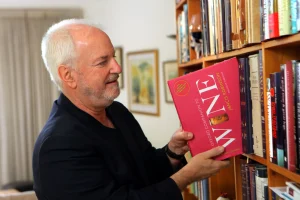
Adam Montefiore is a wine trade veteran and winery insider turned wine writer, who has advanced Israeli wines over four decades. He is referred to as the ‘English voice of Israeli wine’ and is the Wine Writer for the Jerusalem Post. www.adammontefiore.com